A few years ago, if someone said a company could be worth over one trillion dollars, many people would have laughed.
Today, that’s no longer surprising.
Companies like Apple, Microsoft, Nvidia, Amazon, and Saudi Aramco have crossed the trillion-dollar mark, proving that massive business growth is possible when a company dominates a large market and becomes essential to everyday life.
But here’s a more interesting question:
Where will the next trillion-dollar companies come from?
It’s a question investors, entrepreneurs, business leaders, and even governments are trying to answer. After all, the companies that reach trillion-dollar valuations often shape the future economy, create millions of jobs, and influence how we live and work.
If you and I were having coffee and discussing the future of business, we’d probably agree on one thing: the next generation of trillion-dollar companies won’t appear by accident. They’ll emerge from industries solving some of the world’s biggest problems and serving billions of people.
Let’s take a closer look at the industries that have the strongest chance of producing the next trillion-dollar giants.
What Makes a Trillion-Dollar Company?
Before jumping into specific industries, it’s worth understanding what all trillion-dollar companies have in common.
Whether it’s Apple selling devices, Microsoft providing software, or Nvidia powering artificial intelligence, they share several key characteristics:
- They operate in enormous global markets.
- Their products or services are difficult to replace.
- They can scale internationally.
- They generate recurring revenue.
- They continuously innovate.
- They build ecosystems rather than single products.
A trillion-dollar company isn’t simply a successful business. It’s a business that becomes deeply integrated into people’s daily lives.
With that in mind, let’s explore the industries that could create the next wave of business giants.
Read More:
1. Artificial Intelligence (AI)
If one industry has captured the world’s attention in recent years, it’s artificial intelligence.
AI is no longer limited to research labs. It’s helping businesses automate tasks, improve customer service, generate content, analyze data, and develop new products.
Think about how quickly AI has become part of everyday life:
- Chatbots answer customer questions.
- AI tools create marketing content.
- Businesses automate repetitive tasks.
- Healthcare providers use AI-assisted diagnostics.
The most important thing about AI is that it doesn’t serve one industry.
It serves nearly every industry.
Why AI Could Create Multiple Trillion-Dollar Companies
Unlike previous technology trends, AI can be applied across healthcare, finance, manufacturing, education, retail, transportation, and entertainment.
That creates an almost unlimited market opportunity.
Risks
- Government regulations
- Data privacy concerns
- High computing costs
- Increasing competition
Even with these challenges, AI currently has the strongest chance of creating multiple new trillion-dollar companies.
2. Semiconductors and Advanced Chips
People often focus on AI software while ignoring the technology powering it.
Without advanced chips, modern AI wouldn’t exist.
Every AI model requires:
- Graphics processing units (GPUs)
- AI accelerators
- Data center processors
- Memory chips
As artificial intelligence expands, demand for semiconductor technology continues to grow.
Why This Industry Has Massive Potential
The world is becoming more digital every year.
Smartphones, vehicles, AI systems, cloud computing platforms, and industrial automation all depend on advanced semiconductors.
In many ways, chips have become the oil of the digital economy.
Risks
- Geopolitical tensions
- Supply chain disruptions
- High manufacturing costs
- Technology cycles
Despite these risks, semiconductor companies remain among the strongest candidates for future trillion-dollar valuations.
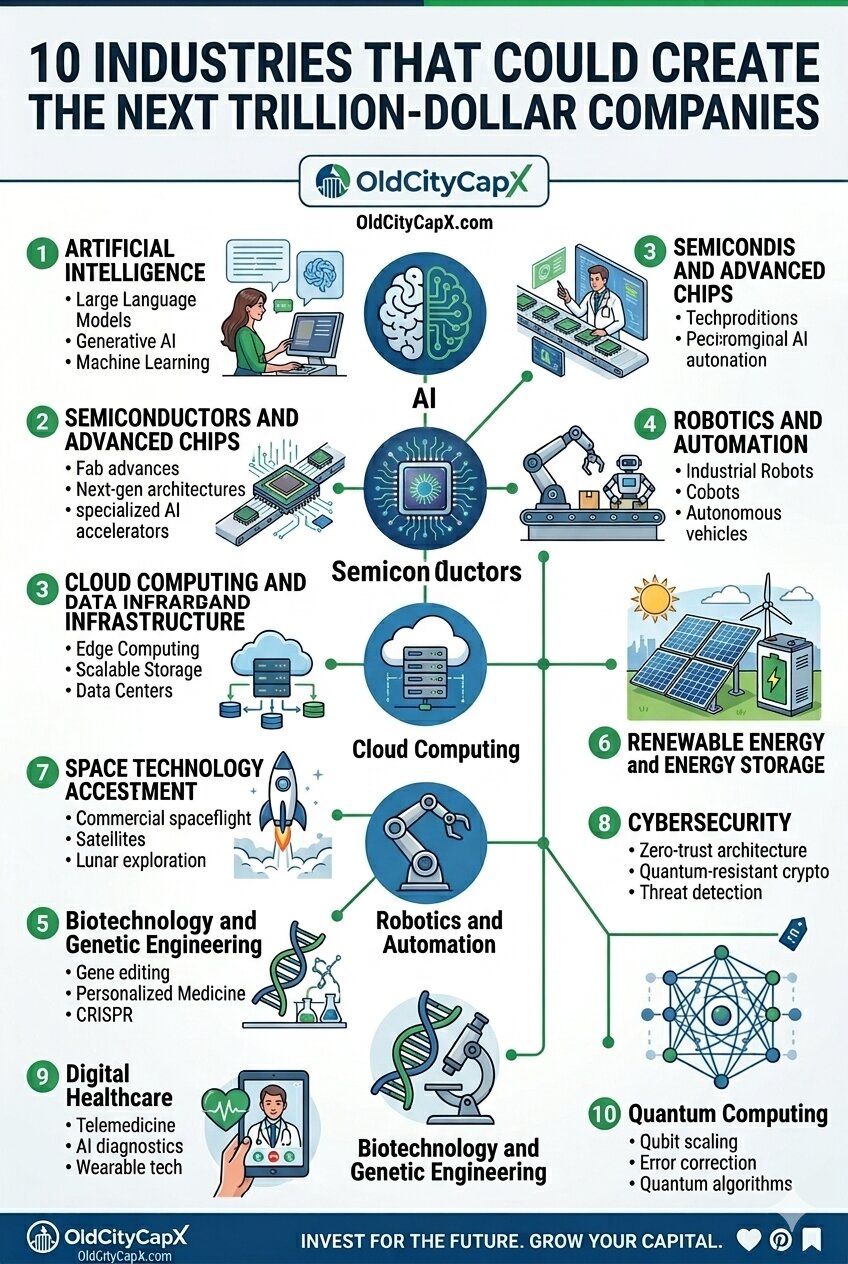
3. Cloud Computing and Data Infrastructure
Every photo you upload, every email you send, and every AI application you use relies on cloud infrastructure.
Cloud computing has become one of the most important foundations of the modern economy.
Businesses increasingly rely on cloud services instead of operating their own servers.
Why Cloud Infrastructure Matters
Artificial intelligence requires enormous amounts of computing power.
As businesses generate more data, demand for cloud storage and data processing will continue growing.
Future opportunities include:
- AI data centers
- Cloud security
- Enterprise software
- Data storage solutions
Risks
- Rising energy costs
- Data privacy regulations
- Increased competition
Still, cloud infrastructure remains one of the most important growth industries of the next decade.
4. Robotics and Automation
Imagine warehouses operating with minimal human intervention.
Factories producing goods around the clock.
Construction sites using robotic equipment.
This isn’t science fiction anymore.
Automation is becoming increasingly attractive as businesses face labor shortages and rising operational costs.
Why Robotics Could Produce a Trillion-Dollar Company
Robotics combines hardware, software, and AI into a powerful business opportunity.
Applications already exist in:
- Manufacturing
- Agriculture
- Logistics
- Healthcare
- Construction
As robots become more affordable and capable, adoption could accelerate dramatically.
Risks
- High development costs
- Public concerns about job displacement
- Regulatory challenges
Even so, the long-term opportunity remains enormous.
5. Biotechnology and Genetic Engineering
Healthcare is one of the world’s largest industries, and biotechnology is changing how diseases are treated.
Researchers are making breakthroughs in:
- Gene editing
- Personalized medicine
- Drug development
- Disease prevention
Why Biotechnology Has Trillion-Dollar Potential
A company that develops treatments for major diseases could create extraordinary value.
Unlike many industries, biotechnology has the potential to improve both human health and economic productivity.
Risks
- Strict regulations
- Lengthy approval processes
- High research costs
- Clinical trial failures
The risks are significant, but so are the rewards.
6. Renewable Energy and Energy Storage
The world is investing heavily in cleaner energy solutions.
As populations grow and technology adoption increases, global energy demand continues rising.
At the same time, governments and businesses are seeking alternatives to traditional fossil fuels.
Key Growth Areas
- Solar energy
- Wind power
- Battery technology
- Energy storage systems
- Smart grids
Why It Could Create Trillion-Dollar Companies
Future technologies such as AI, electric vehicles, and cloud computing require enormous amounts of electricity.
Whoever helps solve future energy challenges could build one of the world’s most valuable businesses.
Risks
- Political uncertainty
- Commodity price fluctuations
- Infrastructure challenges
7. Space Technology
A few decades ago, space was almost entirely controlled by governments.
Today, private companies are changing that.
The space economy includes:
- Satellite internet
- Space transportation
- Earth observation services
- Future lunar infrastructure
Why Space Could Become a Trillion-Dollar Industry
Global internet access, satellite communications, and future space-based services represent huge opportunities.
The industry remains young, which means the biggest winners may not have emerged yet.
Risks
- Extremely high capital requirements
- Long development timelines
- Regulatory barriers
Space remains a high-risk but potentially high-reward industry.
8. Cybersecurity
The more connected the world becomes, the more important cybersecurity becomes.
Businesses store enormous amounts of sensitive information online.
Protecting that information is now essential.
Why Cybersecurity Will Continue Growing
Every new technology creates new security challenges.
Artificial intelligence, cloud computing, and digital healthcare all require strong cybersecurity solutions.
Risks
- Constant technological change
- Intense competition
- Evolving cyber threats
The need for digital security isn’t disappearing anytime soon.
9. Digital Healthcare
Healthcare is rapidly becoming more technology-driven.
Patients increasingly use digital tools to monitor health, access medical records, and communicate with healthcare providers.
Growth Opportunities
- Telemedicine
- AI diagnostics
- Health monitoring devices
- Preventive healthcare platforms
Why This Industry Matters
Many healthcare systems struggle with rising costs and growing demand.
Digital healthcare solutions can improve efficiency while expanding access to care.
Risks
- Privacy regulations
- Security concerns
- Slow adoption in some markets
Despite these challenges, digital healthcare continues to expand globally.
10. Quantum Computing
Quantum computing is still developing, but many experts believe it could eventually transform entire industries.
Unlike traditional computers, quantum systems can solve certain problems much faster.
Potential applications include:
- Drug discovery
- Financial modeling
- Logistics optimization
- Advanced cybersecurity
Why It Could Create Massive Businesses
Companies that successfully commercialize quantum computing could unlock entirely new markets.
Risks
- Technology remains immature
- High research costs
- Commercial adoption uncertainty
Quantum computing may be a long-term opportunity rather than a short-term one.
Comparing the Industries
Not all industries have the same chance of creating trillion-dollar companies.
Here’s a simple comparison based on current market trends and long-term potential.
| Industry | Trillion-Dollar Potential | Risk Level |
|---|---|---|
| Artificial Intelligence | Very High | Medium |
| Semiconductors | Very High | Medium |
| Cloud Computing | Very High | Medium |
| Robotics | High | Medium |
| Biotechnology | High | High |
| Renewable Energy | High | Medium |
| Space Technology | High | High |
| Cybersecurity | Medium-High | Medium |
| Digital Healthcare | Medium-High | Medium |
| Quantum Computing | Medium | Very High |
Revenue Potential by Industry
One of the biggest questions is market size.
After all, trillion-dollar companies typically emerge from trillion-dollar markets.
| Industry | Estimated Long-Term Market Potential |
|---|---|
| Artificial Intelligence | $15–20+ Trillion |
| Renewable Energy | $4–10 Trillion |
| Cloud Computing | $3–5 Trillion |
| Robotics | $2–5 Trillion |
| Biotechnology | $2–4 Trillion |
| Space Economy | $1–2 Trillion |
| Semiconductors | $1–3 Trillion |
| Digital Healthcare | $1–3 Trillion |
| Cybersecurity | $500 Billion–$1 Trillion |
| Quantum Computing | $500 Billion–$2 Trillion |
These estimates will change over time, but they highlight where future opportunities may emerge.
What Investors Should Watch
If you’re interested in long-term wealth creation, watch industries rather than individual stocks.
Pay attention to:
- AI infrastructure
- Semiconductor manufacturing
- Cloud computing platforms
- Renewable energy innovation
- Cybersecurity solutions
The biggest opportunities often appear years before they become obvious.
What Entrepreneurs Should Watch
Entrepreneurs should focus on solving problems rather than chasing trends.
Look for:
- Inefficiencies in healthcare
- AI automation opportunities
- Energy storage challenges
- Cybersecurity gaps
- Robotics applications for small businesses
Many trillion-dollar companies began by solving simple problems in a better way.
What Digital Marketers Should Watch
For marketers, these industries represent growing content and advertising opportunities.
Areas likely to attract attention include:
- AI tools and software
- Cybersecurity education
- Renewable energy awareness
- Healthcare technology
- Robotics innovation
The businesses shaping these industries will need strong marketing strategies to reach customers.
Frequently Asked Questions
Which industry is most likely to create the next trillion-dollar company?
Artificial intelligence currently has the strongest potential because it affects nearly every major industry and continues attracting significant investment worldwide.
Can startups become trillion-dollar companies?
Yes. Many of today’s largest companies started as small startups before scaling globally through innovation and market expansion.
Will AI create more trillion-dollar companies than any other industry?
Possibly. AI has applications across healthcare, finance, education, manufacturing, transportation, and entertainment, giving it an unusually large addressable market.
Is the space industry still a risky investment?
Yes. Space technology offers significant long-term opportunities, but it requires large amounts of capital and often involves long development timelines.
Why are semiconductors so important?
Semiconductors power smartphones, computers, cloud infrastructure, AI systems, vehicles, and countless other technologies. They are essential to the digital economy.
Final Thoughts
Predicting the future is never easy.
If history teaches us anything, it’s that the world’s biggest companies often emerge from technologies that transform how people live and work.
Today, artificial intelligence, semiconductors, cloud computing, robotics, biotechnology, renewable energy, cybersecurity, digital healthcare, quantum computing, and space technology are among the strongest candidates.
Not every company in these industries will succeed. Many will fail.
But somewhere within these sectors, the next trillion-dollar businesses are likely being built right now.
The companies that solve major problems, serve global markets, and continue innovating will have the best chance of joining the trillion-dollar club in the years ahead.

0 Comments