Trillion Dollar Club: Top 10 Most Valuable Companies Ranked (2026 Updated List)
The global economy is changing faster than ever, and it honestly feels like the rules keep getting rewritten. Not too long ago, reaching a billion-dollar—or even trillion-dollar—valuation was seen as the ultimate achievement for any company. But today, that level doesn’t feel like the ceiling anymore. The bar has moved again, and the scale of corporate value has entered a completely new era.
Welcome to the Trillion Dollar company list—an elite, highly exclusive group of global giants and market leaders whose individual market valuations rival the entire Gross Domestic Product (GDP) of major sovereign nations.
Driven largely by an explosive, multi-year super cycle in Artificial Intelligence (AI) infrastructure, these mega-cap powerhouses do not merely participate in the global economy; they fundamentally dictate its direction. For everyday retail investors and seasoned institutions alike, tracking these massive blue chip stocks is the most effective way to gauge the technological and financial trends shaping our collective future.
In this comprehensive, data-driven guide, we analyze the trillion dollar companies list, break down the mechanics behind their astronomical valuations, and reveal the top 10 most valuable companies in the world as of mid-2026.
What is Market Capitalization? (A Simple Explanation)
Before diving into the official rankings, it is essential to understand exactly how we measure corporate value on the public stock exchanges. Wall Street and global financial bodies evaluate these corporate behemoths using a clean, objective metric known as Market Capitalization (or “market cap”).
Fortunately, the underlying math is remarkably straightforward:
$$\text{Market Capitalization} = \text{Total Outstanding Shares} \times \text{Current Share Price}$$
Think of market cap as the hypothetical price tag required to buy 100% of a company outright at this exact second on the open market.
Important Distinction: Market cap is entirely separate from a company’s actual revenue or physical assets. A company might generate hundreds of billions in physical product sales, but if investors do not anticipate explosive future earnings growth, its market cap will remain lower. Conversely, a firm that controls a critical bottleneck in global technology can see its market capitalization skyrocket to historic highs purely based on forward-looking investor demand.
Our Ranking Criteria
To construct this definitive 2026 list, companies are evaluated and organized based on their real-time public market capitalization in United States Dollars (USD).
While total annual revenue and qualitative global influence are vital components of a company’s broader economic footprint, public equity market value serves as our primary sorting mechanism. For state-owned or partially privatized organizations, we prioritize the valuation of their publicly traded equity tracking data across leading international exchanges.
The Top Trillion-Dollar Companies in the World (2026)
The current elite layer of the global markets features a fascinating mix of unprecedented tech dominance, critical semiconductor manufacturing bottlenecks, and structural energy giants.
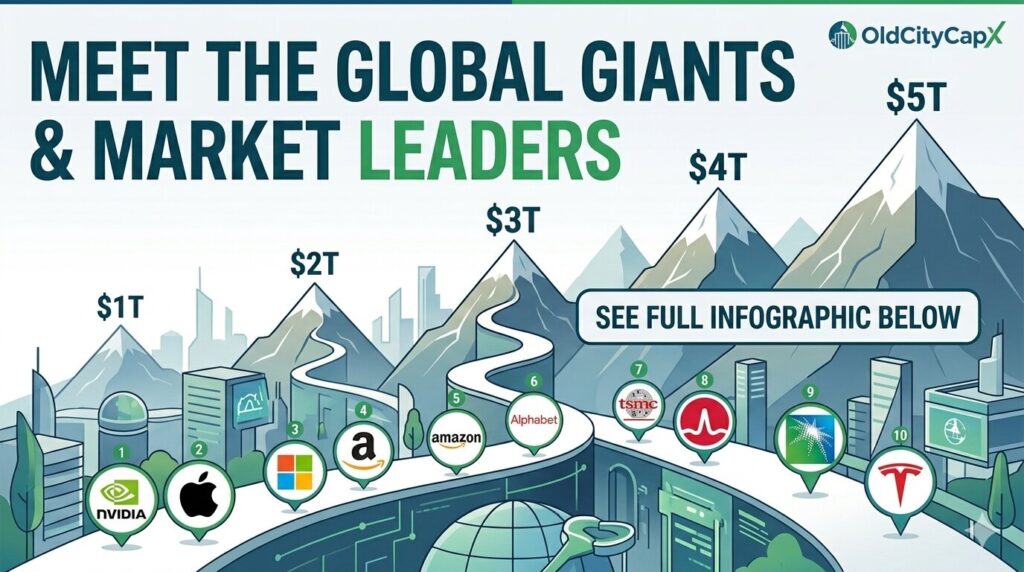
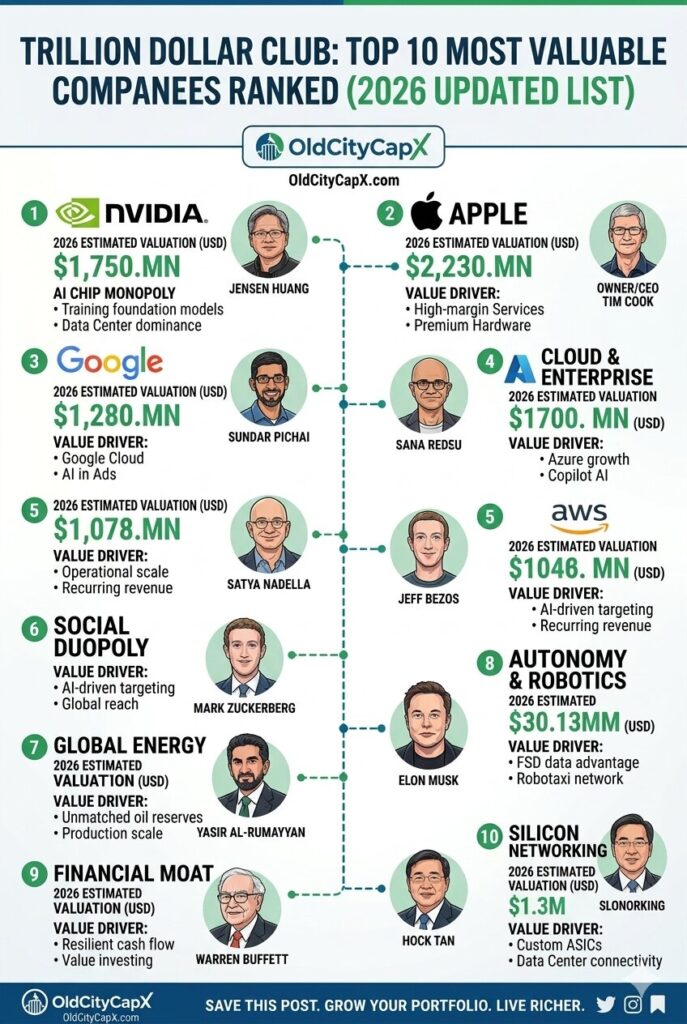
The data below outlines the official top 10 standings for mid-2026.
| Rank | Company Name | Market Cap (USD) | Industry | Country | Primary Value Driver |
| 1 | NVIDIA | $5.11 Trillion | Semiconductors / AI | 🇺🇸 United States | Monopoly on AI training GPUs & CUDA software |
| 2 | Apple | $4.58 Trillion | Consumer Tech / Services | 🇺🇸 United States | Massive hardware ecosystem & high-margin services |
| 3 | Alphabet (Google) | $4.56 Trillion | Internet / Software / AI | 🇺🇸 United States | Search dominance, YouTube, and Google Cloud AI |
| 4 | Microsoft | $3.34 Trillion | Enterprise Software / Cloud | 🇺🇸 United States | Azure Cloud infrastructure & Copilot AI integration |
| 5 | Amazon | $2.91 Trillion | E-Commerce / Cloud Computing | 🇺🇸 United States | AWS cloud leadership & retail operational scale |
| 6 | TSMC | $2.17 Trillion | Semiconductor Foundry | 🇹🇼 Taiwan | Exclusive fabricator of the world’s most advanced chips |
| 7 | Broadcom | $2.11 Trillion | Semiconductors / Software | 🇺🇸 United States | Custom silicon designs & critical data center routing |
| 8 | Saudi Aramco | $1.80 Trillion | Oil & Gas / Energy | 🇸🇦 Saudi Arabia | Unmatched physical oil reserves and low extraction costs |
| 9 | Tesla | $1.63 Trillion | Automotive / Clean Energy | 🇺🇸 United States | EV market leadership, autonomy, and energy storage |
| 10 | Meta Platforms | $1.60 Trillion | Social Media / Digital Ads | 🇺🇸 United States | Global communication duopoly & core AI ad targeting |
Inside the Trillion Dollar Giants: A Deep-Dive Look
To genuinely appreciate why these specific companies command such immense premiums from the global investment community, we must analyze the structural advantages and moats behind each asset.
1. NVIDIA (NVDA) — $5.11 Trillion
NVIDIA has accomplished what many economists once deemed impossible, firmly holding its position as the undisputed king of the global stock markets. The engine behind this historic rise is simple: NVIDIA effectively holds a functional monopoly on the specialized hardware powering the global artificial intelligence revolution.
Its graphics processing units (GPUs) are the baseline foundational infrastructure required to train and deploy Large Language Models (LLMs). Furthermore, its proprietary software stack, CUDA, creates an airtight ecosystem that prevents enterprise clients from easily switching to emerging competitors.
2. Apple (AAPL) — $4.58 Trillion
Apple remains a masterclass in consumer monetization and ecosystem lock-in. By marrying highly optimized consumer hardware with an increasingly profitable, high-marginServices division (App Store, iCloud, Apple Music, and financial services), Apple converts casual users into lifelong customers. As artificial intelligence moves directly onto edge-compute devices like smartphones and laptops, Apple’s direct, secure relationship with billions of global users keeps its premium valuation secure.
3. Alphabet (GOOGL) — $4.56 Trillion
Alphabet, the powerhouse parent of Google, continues to leverage its historic digital advertising fortress. Google Search and YouTube remain the internet’s primary gateways, generating massive, ultra-consistent free cash flow. Simultaneously, Google Cloud has grown into an absolute titan, providing enterprise clients with the immense computational horsepower and native AI frameworks required to process modern data workloads at scale.
4. Microsoft (MSFT) — $3.34 Trillion
Microsoft acts as the digital nervous system for the modern corporate world. Its core enterprise offerings—Windows, Office 365, and its dominant Azure cloud computing platform—are deeply woven into global business operations. Through its strategic partnership with OpenAI and the deep structural integration of AI Copilots across its entire software suite, Microsoft has successfully monetized generative enterprise tools faster than almost any other software ecosystem on the planet.
5. Amazon (AMZN) — $2.91 Trillion
Amazon operates a highly efficient dual engine of global commerce and technological infrastructure. While its e-commerce network handles unparalleled physical retail logistics globally, the true financial crown jewel is Amazon Web Services (AWS). AWS remains the foundational cloud layer for a staggering percentage of the modern internet, yielding highly dependable, recurring enterprise revenue that funds Amazon’s continuous logistical expansions.
6. TSMC (TSM) — $2.17 Trillion
Taiwan Semiconductor Manufacturing Company (TSMC) is arguably the single most geopolitically and technologically critical corporation on earth. As an pure-play independent foundry, TSMC does not design its own chips; instead, it physically manufactures the highly complex silicon designed by Apple, NVIDIA, AMD, and Broadcom. Because it is the only entity globally capable of reliably producing sub-3-nanometer microchips at commercial scale, TSMC commands absolute pricing power over the tech industry.
7. Broadcom (AVGO) — $2.11 Trillion
Broadcom is the quiet engineer behind the world’s interconnected data systems. Specializing in custom application-specific integrated circuits (ASICs) and highly advanced networking hardware, Broadcom creates the underlying switches, routers, and co-processors that allow massive data centers to transfer information smoothly. Its brilliant, decade-long acquisition strategy has built a highly defensive moat across both infrastructure hardware and mission-critical enterprise software.
8. Saudi Aramco (2222.SR) — $1.80 Trillion
The sole traditional energy representative in the top tiers of the trillion dollar companies 2026 rankings, Saudi Aramco is the national oil company of Saudi Arabia. Despite the ongoing global transition toward renewable energy, the world’s structural baseline infrastructure remains completely dependent on fossil fuels. Aramco possesses the lowest per-barrel extraction costs and the largest proven crude reserves on the planet, making it an absolute cash-generating machine.
9. Tesla (TSLA) — $1.63 Trillion
Tesla effortlessly transcends the traditional definition of an automotive company. While it remains the undisputed global leader in battery-electric vehicle (BEV) production, institutional investors value Tesla primarily as a robotics, autonomy, and energy storage platform. Its vast fleet of real-world vehicles continuously feeds driving data into its centralized AI training clusters, putting it at the forefront of scalable autonomous driving networks.
10. Meta Platforms (META) — $1.60 Trillion
Meta Platforms commands the daily attention of over 3 billion active users across its family of apps, including Facebook, Instagram, WhatsApp, and Threads. By utilizing heavily advanced internal AI recommendation systems to dramatically boost user engagement and precision ad-targeting, Meta converts social interaction into elite-tier advertising revenues, rounding out our exclusive top ten list.
Sector Breakdown: What Industries Dominate?
When analyzing the macro architecture of the modern stock market, it becomes painfully clear that tech-centric models have utterly consumed alternative sectors.
┌─────────────────────────────────────────────────────────────┐
│ 2026 GLOBAL VALUE DISTRIBUTION BY SECTOR                    │
├──────────────────────────────┬──────────────────────────────┤
│ Technology & AI              │ ████████████████████ (80%)   │
│ Energy                       │ ████ (10%)                   │
│ Diversified / Financial      │ ██ (5%)                      │
│ Consumer / Other             │ ██ (5%)                      │
└──────────────────────────────┴──────────────────────────────┘
- Technology & AI Infrastructure: This vertical reigns completely supreme. Out of the top ten global entities, eight are tied explicitly to advanced computing hardware, hyperscale cloud structures, consumer ecosystems, or semiconductor fabrication.
- Energy: Traditional fossil fuel extraction remains structurally significant via Saudi Aramco, but its relative share of the apex market cap tier has visibly contracted compared to the digital economy.
- The Supply Chain Shift: The emergence of pure-play chip manufacturers (TSMC) and networking architects (Broadcom) directly into the top ten highlights a vital reality: control over the physical bottlenecks of computing infrastructure is currently valued higher than legacy banking or consumer retail frameworks.
The Underlying Catalysts: Why Are These Companies So Valuable?
The historic asset concentrations we observe in the trillion dollar companies 2026 list are driven by three compounding economic factors:
- The AI Capital Expenditure Wave: Global enterprises, hyperscalers, and sovereign states are projected to spend over $650 billion on artificial intelligence infrastructure this year alone. This massive capital shift goes directly into the pockets of the foundational component suppliers and cloud platforms listed above.
- Unrivaled Global Scalability: Unlike legacy industrial firms that required massive physical factories to scale outputs, modern software and digital cloud ecosystems can onboard millions of new users instantly with near-zero marginal production costs.
- Fortress Balance Sheets: The members of this elite club are sitting on enormous mountains of cash. This allows them to seamlessly buy out threatening early-stage competitors, invest billions into speculative internal R&D, and aggressively execute massive stock buyback programs that structurally boost individual share prices.
Future Predictions (2030): Who Joins Next?
The expansion of the trillion-dollar frontier shows absolutely no signs of stopping. As capital continues to flow down the technology and hardware value chains, several major financial powerhouses and emerging tech giants are fast approaching the 12-figure milestone.
Looking toward 2030, the top candidates to join this exclusive group include:
- Samsung Electronics & SK Hynix: Driven by an acute global shortage of advanced high-bandwidth memory (HBM) chips required for AI processors, these South Korean semiconductor titans are experiencing massive revenue surges and are prime candidates for stable long-term trillion-dollar entries.
- Berkshire Hathaway (BRK.A / BRK.B): Warren Buffett’s iconic investment conglomerate has multiple times crossed the historic $1 trillion threshold. Backed by highly resilient cash flows from insurance, energy, railroads, and an enormous public stock portfolio, it remains the ultimate defensive value play.
- Eli Lilly (LLY): Propelled by the unprecedented global demand for its breakthrough metabolic and weight-management medications, this healthcare pioneer is growing at a clip that could easily make it the first pure pharmaceutical company to permanently claim a trillion-dollar valuation.
Frequently Asked Questions (FAQ)
What is a trillion dollar company?
A trillion-dollar company is a publicly traded corporation whose total market capitalization (calculated by multiplying the total outstanding shares by the current individual stock price) reaches or surpasses $1,000,000,000,000 USD.
Which is the most valuable company in the world in 2026?
NVIDIA (NVDA) is the most valuable company in the world, holding an incredible market valuation of over $5.11 trillion USD due to its essential dominance in the production of AI semiconductor hardware.
How do companies reach a trillion-dollar valuation?
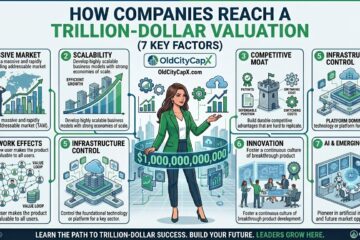
Companies scale to these historic sizes by constructing massive competitive moats, developing highly scalable digital infrastructure, maintaining global product demand, and dominating high-margin market sectors like enterprise cloud computing and artificial intelligence.
Why is Apple so valuable?
Apple is valuable due to its incredible ecosystem stickiness, immense consumer brand loyalty, premium pricing power, and a high-margin Services division that captures consistent recurring revenue from an active global user base numbering in the billions.
Which industries create the most trillion-dollar companies?
The technology sector—specifically cloud computing, semiconductor manufacturing, automated software systems, and AI infrastructure development—is the primary engine creating trillion-dollar valuations in the modern economy.
Conclusion and Future Outlook
The updated trillion dollar companies list for 2026 signals a definitive reality: we are living in a completely transformed global economy. Valuations are no longer bound by historical linear growth models. Instead, corporations that successfully position themselves at the center of global network nodes, data generation, and specialized hardware manufacturing are scaling to heights that were unimaginable just a decade ago.
As an investor, tracking these market leaders is not about chasing past performance—it is about mapping the structural architecture of future global commerce. While the order of these top ten giants will undoubtedly shift as market cycles fluctuate, their collective grip on our technological and financial reality is here to stay.


0 Comments